



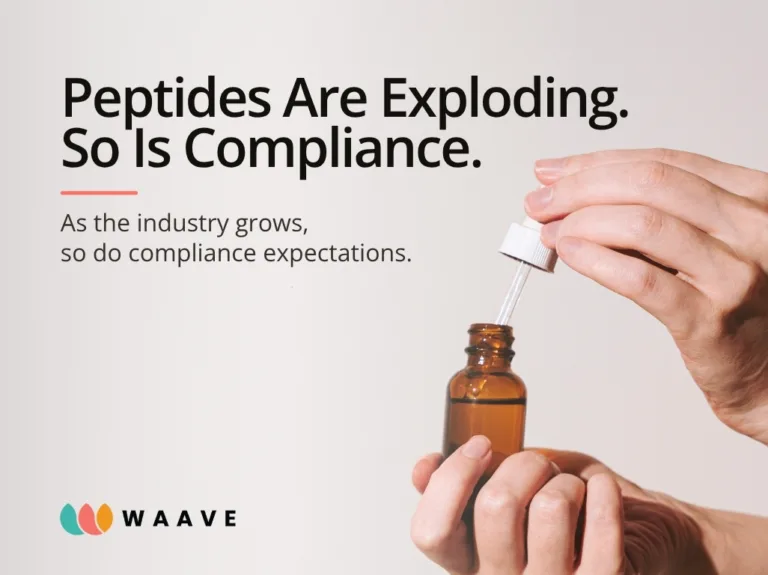
The peptide industry has changed dramatically over the past few years.
What was once a niche market has become one of the fastest-growing segments in wellness commerce. New suppliers appear every month, demand continues to rise, and consumers have become increasingly aware of research peptides and related products.
Growth is exciting.
But it also attracts attention.
Banks, payment processors, regulators, hosting providers, and card networks are paying closer attention to the industry than ever before. As more businesses enter the market, compliance expectations continue to rise.
Today, selling peptides isn’t just about having quality products. It’s about proving your business operates responsibly.
Growth Always Brings More Scrutiny
Every rapidly growing industry follows a similar pattern.
As sales increase, more companies enter the market. Some follow the rules. Others don’t.
Eventually, financial institutions begin treating the entire category with greater caution.
We’ve already seen this happen with CBD, kratom, vaping products, and hemp. Peptides are following the same path.
That doesn’t mean compliant merchants can’t succeed.
It means they need to separate themselves from businesses creating unnecessary risk.
Why Banks Are Becoming More Conservative
From a bank’s perspective, every merchant represents potential risk.
They’re evaluating much more than chargebacks or processing volume.
They also look at:
- Website content
- Product descriptions
- Regulatory exposure
- Intellectual property concerns
- Marketing language
- Customer acquisition methods
- Ongoing compliance
Two peptide merchants selling similar products can receive completely different underwriting decisions based solely on how their businesses present themselves online.
Compliance has become part of risk management.
“Research Use Only” Isn’t Enough
Many sellers believe adding a “Research Use Only” disclaimer solves the problem.
It doesn’t.
Banks and compliance teams review the entire website—not just one sentence at the bottom of the page.
If a product is labeled for research but the website discusses dosing, expected results, transformations, or other human-use language, the disclaimer loses credibility.
Every page should support the same message.
Consistency matters.
Website Content Is Under Greater Review Than Ever
Many merchants are surprised by what compliance teams actually examine.
They’re looking beyond checkout pages.
Reviews often include:
- Product titles
- Collection pages
- Blog articles
- FAQ sections
- Images
- Metadata
- Customer reviews
- Educational resources
- Social media links
A single page containing prohibited language can create unnecessary underwriting delays or trigger additional reviews.
The larger your website becomes, the easier it is for these issues to go unnoticed.
Compliance Doesn’t Stop After Approval
Receiving a merchant account isn’t the finish line.
Many sellers assume they’re “approved” and can freely update products, launch new collections, or rewrite product pages.
In reality, many payment providers continue monitoring merchant websites after onboarding.
Adding new products, changing website language, or introducing higher-risk inventory can change a merchant’s overall risk profile.
That’s why ongoing compliance is becoming just as important as initial underwriting.
The Cost of Small Mistakes Keeps Growing
Many compliance issues don’t begin with intentional misconduct.
They begin with small changes.
A new product description.
A supplier image.
A blog post copied from somewhere else.
A social media campaign using prohibited language.
Individually, these changes may seem insignificant.
Together, they can alter how banks and processors view your business.
Fixing those issues after they’ve been identified is usually far more difficult than preventing them in the first place.
Merchants Who Invest in Compliance Gain Stability
As the peptide market becomes more competitive, compliance is becoming a competitive advantage.
Merchants who maintain clear website language, accurate product information, proper disclosures, and consistent policies tend to experience fewer underwriting issues, smoother banking relationships, and greater long-term stability.
Compliance isn’t about making your website harder to sell from.
It’s about making your business easier to trust.
And in today’s peptide industry, trust is becoming one of the most valuable assets a merchant can have.
How WAAVE Helps Peptide Merchants
WAAVE combines payment processing with continuous compliance tools built specifically for high-risk wellness industries. From website monitoring and transactional compliance to age verification, geofencing, and ongoing merchant reviews, we help peptide businesses reduce risk while maintaining stable payment processing and stronger banking relationships.