


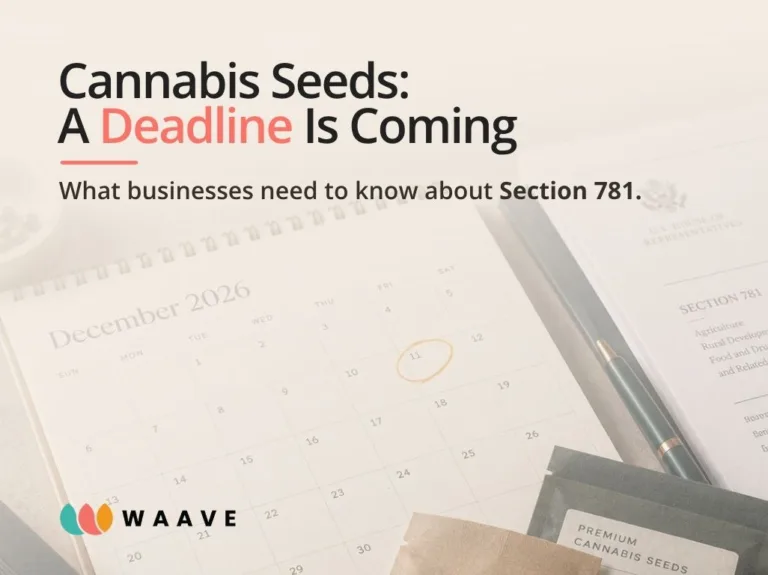
If you sell cannabis genetics or seeds online, December 11, 2026 is a date you need to have on your calendar.
But it is not necessarily the end of the story.
Congress has already intervened once to give the hemp and cannabis industries additional time, and several competing proposals are now attempting to determine what the federal framework will ultimately look like.
For seed banks, breeders, genetics companies, e-commerce merchants and the financial institutions that support them, the next few months are going to be important.
At WAAVE, we’re watching those developments closely—and, more importantly, we’re already working with our processing and compliance partners on what compliant commerce can look like if the current law takes effect.
So, What Actually Changes?
Section 781 changes the federal definition of hemp in several significant ways.
For the cannabis seed industry, one provision is particularly important.
Under the new definition, viable cannabis seeds can be excluded from the federal definition of hemp based on the THC concentration of the plant from which those seeds originate.
That’s a major departure from how seeds have traditionally been treated.
Under the current framework, the seed itself contains little or no meaningful THC. The new standard looks beyond the seed and considers the genetics of the plant that produced it. In practical terms, viable seeds originating from Cannabis sativa L. plants exceeding 0.3% total THC, including THCA, on a dry-weight basis would no longer qualify as hemp under the new federal definition. For businesses selling high-THC cannabis genetics nationally, that’s a very big change.
Why December 11?
The original Section 781 changes were scheduled to become effective in November 2026.
Congress has since stepped in.
A federal funding measure signed in September delayed most of the new Section 781 restrictions until December 11, 2026, creating an additional window for lawmakers and the industry to work toward a longer-term solution.
That matters for another reason: Congress has now demonstrated that it can—and will—revisit this issue.
December 11 is therefore the current deadline. It should absolutely be taken seriously. But it should not be interpreted as proof that the regulatory framework we’re looking at today will necessarily be the final framework governing the industry.
Can Congress Change It Again?
Yes.
Section 781 is federal legislation. Congress can amend it, delay portions of it, replace it with another regulatory framework or repeal it through subsequent legislation. And lawmakers are already proposing alternatives.
The bipartisan Hemp Planting Predictability Act, introduced by Senator Amy Klobuchar with Senators Rand Paul and Jeff Merkley, was designed to provide significantly more time before the new hemp restrictions become effective.
Representative Nancy Mace’s American Hemp Protection Act takes a more direct approach: it proposes repealing Section 781 altogether.
Meanwhile, Senators Ron Wyden and Jeff Merkley have proposed the Cannabinoid Safety and Regulation Act, which represents another philosophy entirely—regulation rather than broad prohibition. That framework emphasizes federal standards including age restrictions, product testing, manufacturing standards and labeling requirements.
These proposals are different, and none should be treated as a guaranteed outcome.
But together they tell us something important: The federal conversation around hemp, cannabis genetics and cannabinoid commerce is very much still happening.
What About Interstate Seed Sales?
This is where seed businesses need to pay particularly close attention.
The 2018 Farm Bill provides federal protection for interstate transportation of products that legally qualify as hemp.
Once certain viable seeds are expressly excluded from the definition of hemp, businesses can no longer simply assume those same federal hemp protections apply to those seeds.
That could materially affect interstate e-commerce, fulfillment and shipping models for cannabis genetics.
It can also affect something WAAVE merchants know very well: Payments.
When the legal classification of a product changes, processors, acquiring banks, card networks and other financial partners have to reassess how—and sometimes whether—that product can be supported.
That’s why waiting until December to start asking these questions isn’t a great strategy.
What Does This Mean for Seeds You Already Own?
The legislation changes the federal classification of products going forward; it does not create a federal program requiring consumers to surrender seeds already sitting in their personal collections.
But federal law and state cannabis laws are two different layers of regulation.
States will continue to have their own rules governing possession, cultivation, commercial cannabis activity and home growing. A state allowing home cultivation does not automatically mean every method of acquiring cannabis genetics across state lines will remain federally permissible.
As always in cannabis, legal in your state and legal in interstate commerce are not necessarily the same question.
What WAAVE Is Doing
This is the part we care about most.
WAAVE has spent years operating in industries where regulations, banking rules and payment requirements change quickly. Our job isn’t to pretend those changes aren’t happening.
Our job is to figure out how legitimate businesses keep operating inside the legal framework.
We are actively working with our processing partners and compliance resources to understand the implications of Section 781 for seed and genetics merchants and to evaluate what compliant processing models may remain available as the federal framework develops.
That includes looking at product classification, merchant underwriting, state restrictions, interstate commerce, website compliance and the requirements our financial partners may impose.
There may not be one universal answer for every merchant. And we’re not going to manufacture one just because it would make for an easier headline.
We’re Still Hopeful
Cannabis and hemp regulation in the United States has rarely moved in a straight line.
The industry has seen new laws, court decisions, agency interpretations, state frameworks and congressional intervention repeatedly reshape what the market looks like.
This time is no different.
Congress has already delayed most of the new restrictions once. Bipartisan lawmakers are actively proposing additional changes. There is a meaningful debate underway about whether prohibition, delay or a regulated federal marketplace is the better solution.
So yes: December 11 matters.
Businesses should prepare for the law that exists today rather than betting their companies on legislation that hasn’t passed.
But preparation and pessimism are not the same thing.
At WAAVE, we’re preparing for the current rules while continuing to work with our partners on solutions that allow compliant businesses to operate.
We’re watching. We’re preparing. We’re working with our processing partners. And we remain hopeful.
Because industries don’t survive regulatory change by ignoring it.
They survive by adapting to it.
This article is provided for general informational purposes and does not constitute legal advice. Federal and state cannabis and hemp laws continue to evolve. Merchants should consult qualified legal counsel regarding their specific products, jurisdictions and business models.