



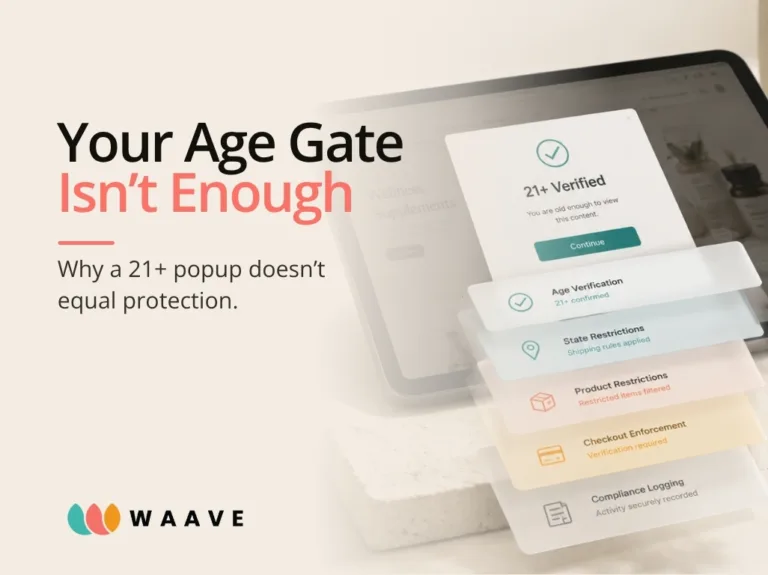
A pop-up asking “Are you 21+?” might look compliant on the surface. But for many wellness sellers, that simple checkbox creates a dangerous assumption: that the business is protected.
In reality, most basic age gates do very little from a compliance or banking perspective.
As regulations tighten around products like kratom, hemp-derived cannabinoids, vapes, nicotine alternatives, and research-use products, financial institutions and regulators are paying closer attention to how businesses restrict access to age-sensitive products. And they’re no longer satisfied with cosmetic protections.
A generic pop-up is not the same thing as a compliance strategy.
Why Basic Age Gates Often Fail
Many websites still use outdated age gates that can be bypassed in seconds. Some only appear once per session. Others disappear permanently after a user clicks “Yes.” In some cases, they do not even store proof that the user interacted with them.
That creates several problems.
First, it becomes difficult to demonstrate that your business actively attempted to prevent restricted purchases from underage buyers.
Second, weak age-gating can raise concerns during underwriting reviews. Payment processors increasingly look at whether merchants have meaningful controls in place — especially in industries considered high-risk.
And third, inconsistent age restrictions across states create additional exposure. Some jurisdictions require stricter verification methods depending on the product category.
A one-size-fits-all age gate rarely reflects those differences.
The Difference Between Visibility and Enforcement
One of the biggest misconceptions in compliance is believing that displaying a warning is the same as enforcing a restriction.
It is not.
A banner that says “21+ only” does not prevent access. It simply informs the visitor of the rule.
Real enforcement involves systems that actively control behavior. That may include:
- Blocking checkout for restricted states
- Triggering additional verification for certain products
- Preventing access before products are viewed
- Logging verification attempts
- Applying different rules based on local regulations
This distinction matters because regulators, banks, and card networks increasingly evaluate operational controls — not just website language.
Why Payment Processors Care About Age Verification
For high-risk industries, age-gating is not only about regulation. It is also tied to financial risk.
Businesses that sell restricted products without meaningful verification controls may face:
- Increased underwriting scrutiny
- Higher reserve requirements
- Monitoring reviews
- Sudden account freezes
- Terminated processing relationships
From a bank’s perspective, weak age controls suggest broader operational risk.
That does not mean every merchant needs government-ID verification at checkout. But it does mean businesses should think beyond the minimum visible requirement.
The goal is to show that compliance is built into the transaction flow — not added as decoration.
State Laws Are Becoming More Specific
The compliance landscape is also changing quickly.
Several states now require stricter age enforcement for kratom, nicotine-related products, hemp-derived products, and other restricted categories. In some cases, laws specifically reference age verification obligations tied to online sales.
What worked two years ago may no longer be sufficient today.
This creates a major challenge for wellness sellers operating nationwide. Different states may require different thresholds, product restrictions, or verification methods.
Without dynamic controls, businesses can accidentally create exposure simply by treating every customer the same way.
What a More Effective Age Gate Looks Like
A stronger approach to age-gating usually includes multiple layers rather than a single pop-up.
That may involve:
- Persistent age verification across sessions
- Product-specific restrictions
- State-based compliance logic
- Checkout enforcement
- Logged verification activity
- Dynamic disclaimers based on jurisdiction
- Additional verification for higher-risk products
Most importantly, the system should work alongside the rest of your compliance operations instead of existing as an isolated website feature.
The businesses surviving long-term in restricted industries are increasingly the ones treating compliance infrastructure as part of normal operations — not just a legal checkbox.
Compliance Is Becoming Operational
The wellness industry has changed significantly over the past few years.
Today, processors, banks, regulators, and platforms are looking beyond surface-level disclosures. They want to see operational controls that actively reduce risk.
That includes how products are marketed, how shipping restrictions are enforced, how disclaimers are displayed, and how age-sensitive products are handled.
An age gate alone will not protect a business if the rest of the transaction flow creates exposure.
And in many cases, the businesses most at risk are the ones that believe they are already covered.
WAAVE provides transactional compliance tools that help wellness merchants apply age-gating, shipping restrictions, dynamic disclaimers, and jurisdiction-based rules directly within the purchase flow.